Offensive Security
Penetration Testing
Adversary-perspective testing that finds what scanners miss.
Uncover real business risk
A penetration test should show you what an adversary could accomplish inside your environment. An automated scan cannot answer that; it hands you a 200-page list of disconnected CVEs. We emulate the tradecraft real attackers use, and we find the flaws and configuration gaps a scan misses.
We show how subtle weaknesses chain together to threaten your sensitive data, your infrastructure, and your revenue. Every finding comes with proof-of-concept steps you can reproduce and remediation guidance your developers can act on.
Scope an assessment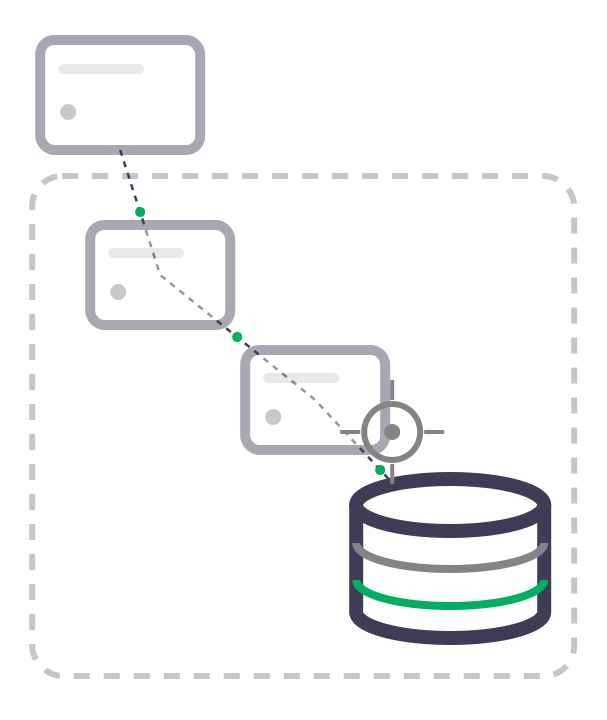
What we test
We don't run automated scans against a generic checklist. Every assessment is scoped around your actual attack surface, technical stack, and business priorities. Most engagements focus on one or more of the following:
Network penetration testing
External testing maps your internet-facing perimeter, identifying exploitable entry points such as exposed management interfaces, vulnerable services, and leaked credentials.
Internal testing assumes an attacker has already breached your perimeter - via a compromised workstation, phishing payload, or insider threat. We emulate real-world adversary tradecraft to evaluate Active Directory and identity boundaries, exploit privilege escalation vectors, and chain lateral movement across subnets to reach your critical infrastructure and sensitive data stores.
Web & API security testing
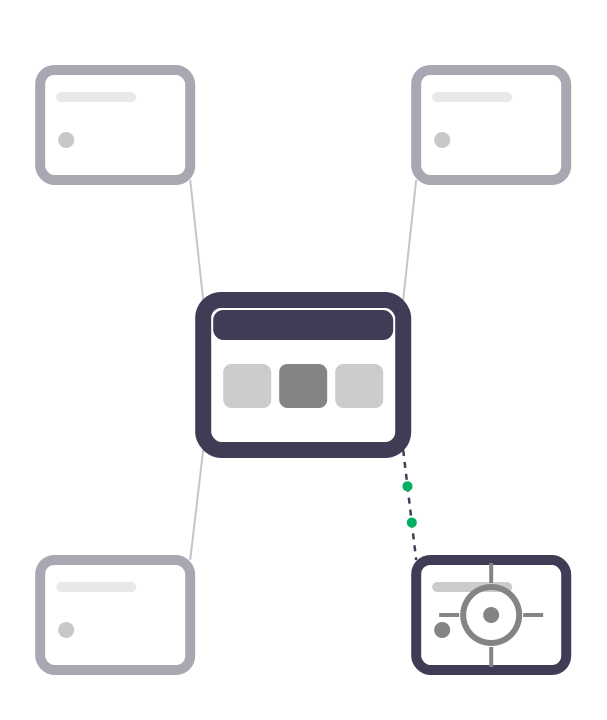
Automated vulnerability scanners excel at flagging missing headers, but they are blind to context. We conduct in-depth, manual offensive assessments targeting your core application business logic, authorization boundaries, and API workflows.
Beyond OWASP Top 10 baselines, we test complex multi-role session management, insecure direct object references (IDOR/BOLA), credential stuffing exposure, and input sanitization flaws. Findings include reproduction steps and developer-ready code patches so your engineering team can remediate root causes quickly.

Our methodology
We follow a structured approach grounded in established frameworks like PTES and the OWASP Web Security Testing Guide (WSTG), adapted to the realities of your environment.
Reconnaissance and scoping
Before testing begins, we establish clear rules of engagement, target definitions, and operational safety boundaries. We then conduct targeted passive and active reconnaissance—mapping your attack surface and identifying external exposures exactly as an adversary would during early campaign phases.

Exploitation and validation
We manually probe for logic flaws, architectural gaps, and misconfigurations, safely chaining weaknesses together to prove real business impact. We don't report theoretical vulnerabilities; we validate what an attacker could truly access, escalate, or exfiltrate, documenting every step along the way.

Reporting and remediation support
Our deliverables speak clearly to both leadership and engineers. Executives receive concise, business-context summaries detailing overall risk posture. Engineering teams receive prioritized, reproducible proofs-of-concept paired with actionable code and configuration fixes. We remain on call post-test to review remediations and answer technical questions.

Built around your compliance requirements
Many organizations conduct penetration tests to satisfy a compliance requirement. We scope every engagement around the specific technical obligations your framework imposes, and we write the report so your assessor can match each finding to the evidence they need.
- PCI DSS - annual and post-change penetration testing under Requirement 11, covering both the network and application layers of your cardholder data environment.
- SOC 2 - evidence of ongoing vulnerability and penetration testing to support the Security and Availability trust services criteria auditors look for.
- HIPAA - technical testing that feeds into the risk analysis required under the Security Rule, identifying vulnerabilities that could expose electronic protected health information.
- CMMC - testing aligned to the assessment objectives your target maturity level requires, documented in a way your assessor can trace back to specific controls.
If you're not sure which of these applies to you, or you're preparing for your first audit, we'll help you figure out what's actually required before we scope anything.
Related services
SOC Efficiency
Detection engineering, alert triage tuning, and SOC workflow optimization for security teams drowning in noise.
Security Consulting
Security program assessment, roadmap, and compliance readiness (SOC 2, PCI DSS, HIPAA, CMMC) for growing organizations.